AI Raises the Skill Floor: The Middle Layer of Knowledge Work Is Most Exposed
Judgment—thresholds, trade-offs, escalation—now separates durable roles from replaceable ones
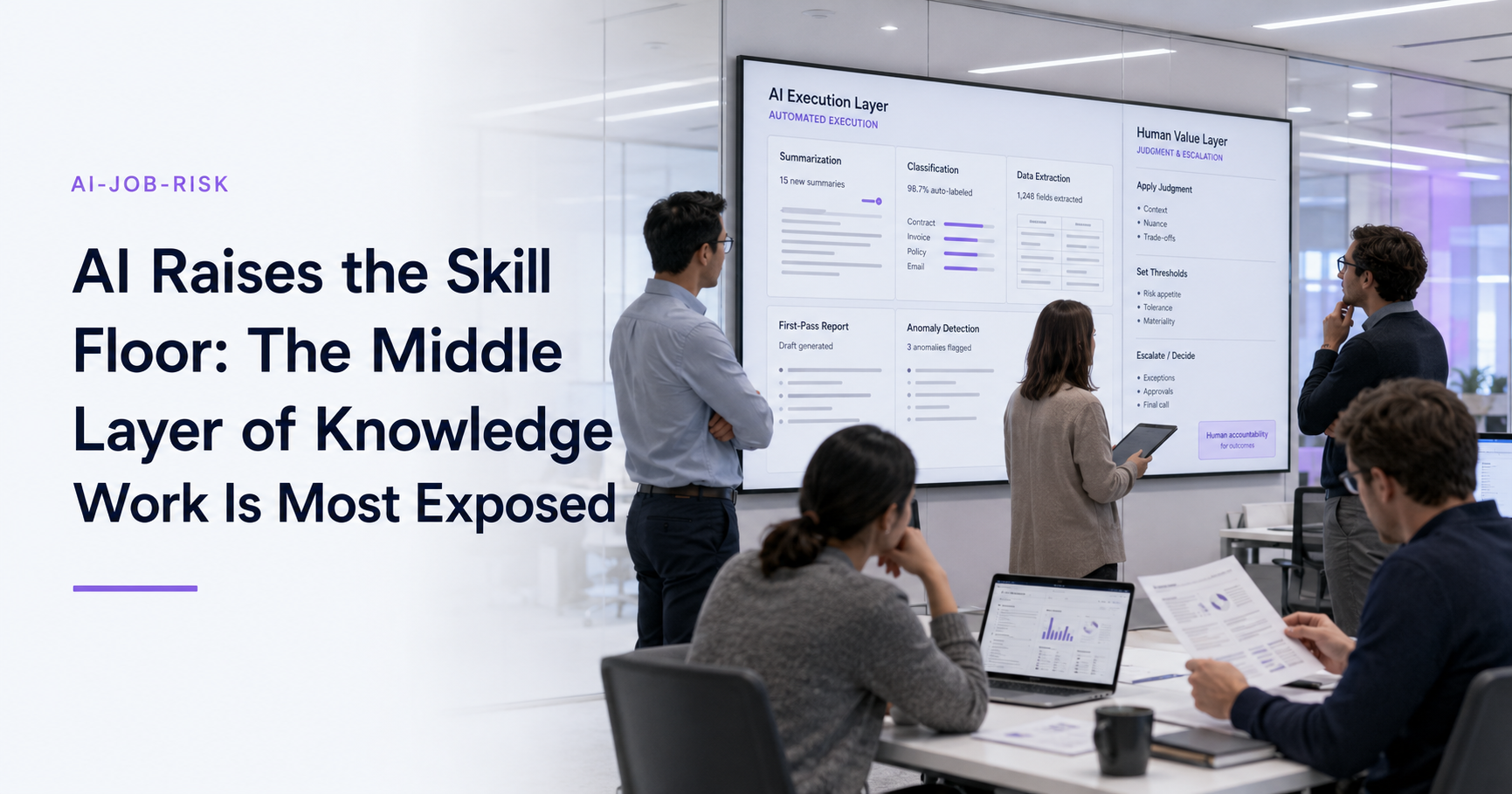
AI is lifting the minimum bar for useful work. The layer most exposed is the middle: people who convert inputs into tidy artifacts without owning decisions. Models now produce summaries, dashboards, and first-pass classifications faster than humans ever did. If your value is packaging signal rather than deciding what to do with it, you are on the line.
The safest skill is judgment. That means setting thresholds tied to loss, owning uncomfortable trade-offs, and knowing when to escalate. These skills are portable across tools and models. They compound with experience rather than decay when a new interface ships.
Why the middle layer is exposed: they translate, they don’t decide. Upper layers set objectives, risk appetite, and constraints. Front lines resolve exceptions and own outcomes. The middle often formats information for someone else’s decision. AI collapses that formatting step. This is the Tool Operator Trap — defining your value by the interface you use rather than the decisions you make.
A concrete scene. A card-testing surge hits an online marketplace late Friday. Authorization declines spike, refund tickets pile up, and the fraud model’s score distribution shifts. In the war room, analysts start building a new dashboard to “understand the shape.” Meanwhile, a senior operator sets a temporary higher threshold to auto-hold suspicious orders, flips on 3DS for a narrow BIN range, and pages payments to lower per-transaction limits for new devices. Losses stop climbing in minutes. The next morning, the team analyzes and tunes. What mattered was not prettier charts, but threshold control and escalation authority.
Here is the minimum viable version of a system that actually works under AI. For a full framework, see the Operational Escalation Framework and the Decision Ownership Model. It is small, explicit, and hard to skip.
1) A single named decision owner per domain. Someone with a pager and write access to thresholds, rules, and kill switches. No committees for incidents. If you cannot name the person who moves the slider at 2 a.m., your system is theater.
2) A defined loss function and friction budget. Write down the cost of a false negative and a false positive in plain terms: dollars, time, customer churn, or safety risk. Set a hard ceiling for acceptable friction. Models change; your cost curve should not be a mystery.
3) Live thresholds with pre-approved playbooks. For each model or heuristic, document the safe range of thresholds and the triggers for moving them. Include exact actions: tighten threshold by X, turn on challenge for segments A/B, or auto-hold orders above amount Y. Add the rollback step. No new analysis needed to act.
4) A narrow, durable metric set. Track only what drives decisions: base rate, precision and recall at the live threshold, queue backlog, and time-to-escalate. Plot them on one page visible to the owner. If a metric never moves a lever, delete it.
5) A reversible change path measured in minutes. Every lever must be changeable within a short, agreed window. Dry-run changes on the last hour of traffic, then go live. If shipping a change takes a ticket and a week, AI will make you look slow even when it is right.
6) An explicit escalation ladder. Define when to move from playbooks to “stop the line.” List names, not teams. Grant authority ahead of time to pause a channel, cap exposure, or block a country while leadership is asleep. Practice this.
7) Closed-loop learning. Every exception and override feeds back into labels, rules, or threshold notes. Make it cheap to add examples and to annotate why a decision was made. Without this, your model drifts — a form of Threshold Drift — and your people repeat last week’s mistakes.
That is the smallest system that actually works. It pairs model speed with human judgment. It is also a mirror. If you cannot fill these blanks today, you likely have a middle layer building artifacts instead of shipping decisions.
The uncomfortable trade-off comes fast: tolerate more customer friction now to stop an active loss, or preserve experience and eat preventable damage while you gather more evidence. AI will not spare you this call. It only brings it to your screen faster and more often.
Strong teams handle that trade-off before the incident. They fix the cost function in writing, give a single owner control of the levers, and rehearse plays until they are boring. They push authority down with guardrails, not up into meetings. Their analysts spend mornings refining thresholds and afternoons validating exceptions, not formatting slide decks. Reporting is not intelligence — the gap between describing what happened and changing what happens next is where value lives.
Average teams delay the hard parts. They tune models for lift on a test set but cannot tie a threshold to dollars. They launch dashboards with no levers attached — a textbook case of Dashboard Sedation. During incidents, they spin up ad hoc channels, argue about data freshness, and escalate responsibility instead of risk — accumulating Escalation Debt. AI makes them faster at producing artifacts that still do not change outcomes.
The middle layer can still thrive, but only by moving up the stack of judgment. Stop treating models as oracles and start treating them as sensors. Convert signal to action with explicit thresholds and owned trade-offs. Automate the repetitive parts of execution, and spend your attention on boundary cases and escalation.
Careers will split the same way systems do. Tool operators will be automated. Decision shapers—people who set thresholds, price errors, and pull levers—will control outcomes. Build toward the latter, and your value rises as models improve.
Choose a side: when the next spike hits, are you the person who moves the threshold and accepts the consequences, or the person the model replaces when it generates the report?