The Analyst Work AI Already Automates—and a One-Week Playbook to Stay in the Room
If AI drafts your queries, charts your spikes, and writes the summary, what’s left is judgment. Set thresholds, own trade-offs, and know when to escalate.
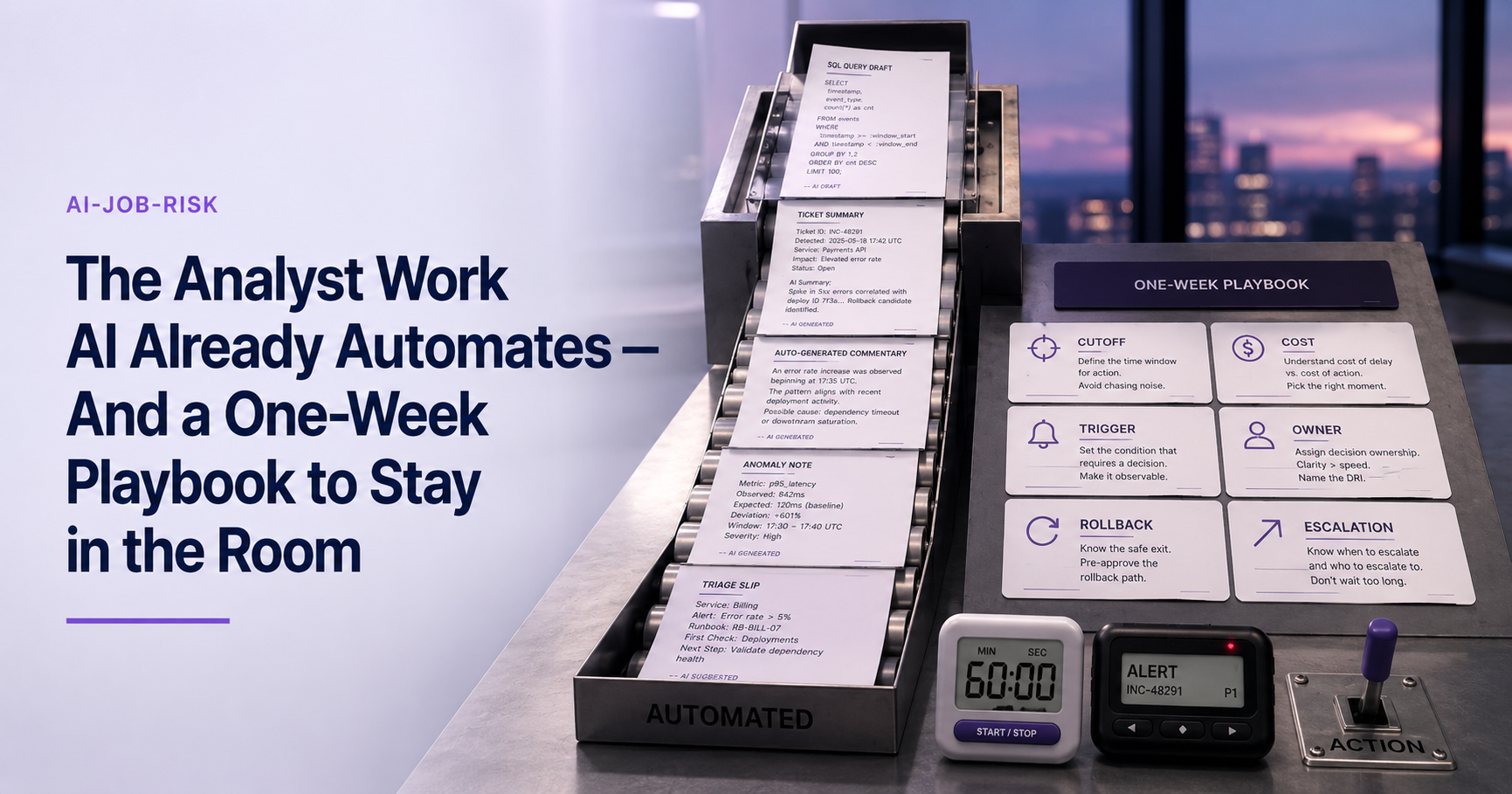
9:17 a.m. Monday. The payments war room fills fast. Card-not-present declines just spiked. Merchants are on hold, support is on fire, and the CFO is in the channel.
Lara, the on-call analyst, opens the incident board. The bot has already posted three drafted SQL queries, a breakdown by BIN, device fingerprint, and MCC, and a 90-day overlay with shaded anomaly bands. It grouped 600 tickets into four themes, wrote a one-paragraph summary for execs, and suggested two playbooks: raise risk score by 12 points or pause payouts to three merchants tied to a new IP cluster.
Nobody asks for a dashboard. They look at Lara. “Pick a move. What’s your cutoff? Who do we notify?”
That’s the job now. AI has eaten the setup. The floor is higher. If you only operate tools, you’re exposed.
Here are the specific tasks AI is removing from analyst roles right now:
- Query drafting and segmentation. Natural language to SQL gets you 80% of exploratory queries. It also suggests joins and common filters.
- Data cleanup and de-duplication. Auto-labeling and embeddings handle fuzzy matches and text normalization well enough for first pass.
- Descriptive analysis. Off-the-shelf anomaly detectors and time-series summaries flag spikes, changepoints, and seasonality.
- KPI commentary. Weekly notes, incident summaries, and “what moved” blurbs are now fast to auto-draft and accurate with light edits.
- Ticket triage. Classification, routing, and merging near-duplicate incidents are reliable with a tuned model and feedback loop.
- Probe generation. The bot proposes hypotheses and checklists of obvious next tests so you don’t start from a blank page.
- Data quality scaffolding. It can draft assertions for what should never be null, out-of-range, or off-ratio, and wire them into checks.
This is good. It removes drag. It’s also dangerous if your value was getting from blank screen to first chart. The scarce skill is judgment: where to set the cutoff, which cost to eat, and when to escalate.
Back to the room. The bot’s two options aren’t equal. Raise the risk score threshold by 12 points and you will block good orders. Pause payouts and you’ll preserve funds but anger clean sellers. There’s no third path that costs nothing. Pick your pain.
Here’s a one-week playbook to stay useful while AI strips out the tool work.
1) Run a task audit and stop doing what the bot does well.
- List your last 10 analyst tasks. Mark which parts the bot can replicate to 80% quality (query drafts, first-pass charts, summaries, triage).
- For those, set a rule: the bot does first pass; you spend time on decision gates, not formatting. Measure your edit time and drive it down.
2) Map your top three recurring decisions to explicit costs.
- For each decision (e.g., raise risk threshold, pause payouts, hold tickets), write a simple cost matrix: false positives, false negatives, time-to-decision burn rate.
- Put real dollar or customer counts on each cost using past incidents. Imperfect is fine. The point is to make trade-offs explicit.
3) Set initial cutoffs and a rollback plan before the next incident.
- For each decision, pre-commit a default threshold and a trigger to revert (e.g., raise by 8 points for 2 hours unless good-order declines exceed X%).
- Put these in a runbook with owner, time budget, and rollback signals. No runbook, no change.
4) Convert passive reports into active triggers.
- Take one dashboard you stare at weekly and turn it into an alert with an action attached. Example: “If chargeback rate > Y basis points for Z hours, enable added verification for these segments.”
- Require the bot to draft the alert and the action message. You approve or adjust. Stop writing commentary no one acts on.
5) Build a one-step escalation path that actually moves money or risk.
- Define who gets paged when a cutoff is hit, what evidence they expect, and the maximum time they can take to say yes or no.
- Kill consensus-by-committee in incidents. One owner. One approver. Everyone else offers context asynchronously.
6) Practice the pressure.
- Run a 60-minute drill using last quarter’s worst spike. Use the bot for prep. Your team must choose a cutoff, execute, and roll back if needed.
- Time each step. Log where you waited for more data when a decision would have been cheap to make and cheap to reverse.
7) Instrument your decisions.
- Keep a decision log: cutoff picked, cost you aimed to minimize, expected side effects, owner, result after 24 and 72 hours.
- Review weekly. Ratchet thresholds based on error costs, not comfort.
This is the uncomfortable trade-off you can’t dodge: accept customer friction today to stop loss, or accept loss today to protect the customer experience. Average teams hide this behind more analysis, prettier charts, and “waiting for the data to settle.” Strong teams pick a side, announce it, and set an automatic rollback.
Average teams also let the bot propose actions while humans keep polishing slides. They treat automation as a junior analyst to babysit. They still write five-page KPI notes the bot already wrote. They escalate late because no one owns the cutoff.
Strong teams do something different. They pre-commit thresholds with pain budgets and timescales. They give the bot authority to prepare, not to decide, and they keep decision rights tight. They attach every metric to a decision and a cost. They test runbooks in drills, not in production for the first time. They accept that some days you buy friction to avoid a bigger loss, and vice versa—and they say it out loud.
Back to Lara. She picks a move: raise the threshold by 8 points for two hours, only on the new device cluster; notify the three merchants and waive fees for clean orders caught in the dragnet; review in 30 minutes with a rollback if good-order declines exceed 1.5x baseline. She posts the plan, tags owners, and hits execute.
Nobody cheers. They move. That’s the job.
So choose: when the bot hands you the queries, the charts, and the draft summary, are you the person who sets the cutoff and pulls the lever now—or the person who asks for one more chart?