AI Exposes Weak Ops and Slow Decisions: Signals Without Authority Become Expensive Noise
Detection got faster. Your decisions didn’t. That gap is where AI projects die.
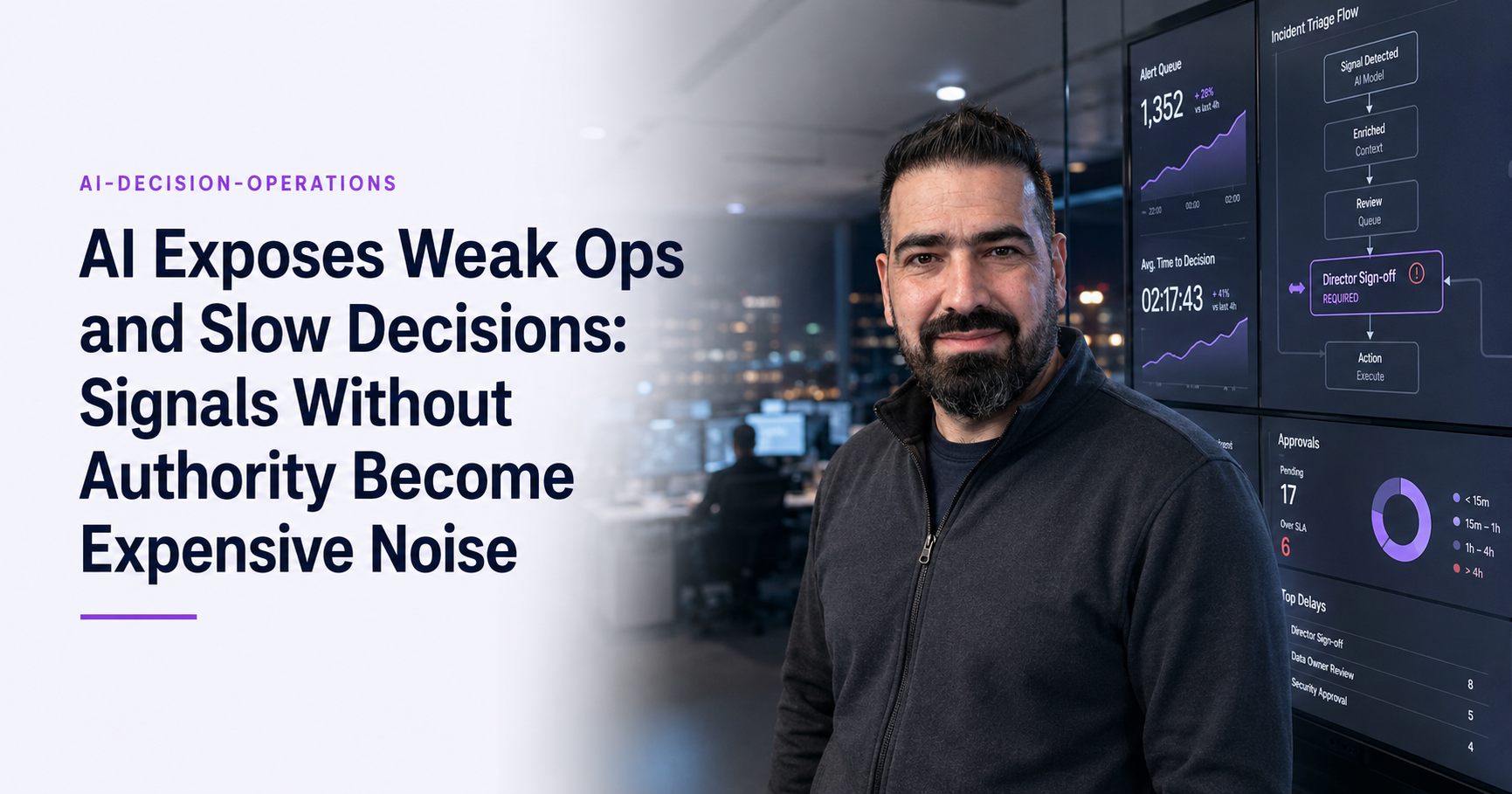
2:17 a.m., the payouts channel turned red.
The new risk model was live for six hours. Alerts spiked from a few dozen a night to hundreds. A junior analyst typed, “Who can hold these payouts?” No one answered for nine minutes. Then someone wrote, “Not me. Needs Director sign-off.”
By sunrise, the queue went from clean to 1,000-plus. The model did its job. It saw patterns fast and at scale. Operations did not. The only people allowed to press “hold” were still asleep.
Here’s the part nobody likes to admit: AI does not repair unclear ownership or slow approval chains. It shows them to you in high definition, faster than you can schedule a meeting. Signals need authority. Without it, detection is just an expensive alarm system.
The hidden cost shows up on a clock and a payroll sheet. In that rollout week, the team burned three nights of on-call overtime and pulled two product managers into triage. Manual review time went from 12 minutes per case to more than an hour because every hold needed a director who was double-booked. By day three, finance paused the model, not because it was wrong, but because decisions were stuck.
That pause cost five business days of lost coverage, three emergency syncs with legal, and two weeks of trust. Everyone felt it. Fraud losses ticked up while the model sat idle. Engineers had to explain why a “successful” pilot made operations worse. The model wasn’t the bottleneck. The org chart was.
This is the process gap nobody talks about. We invest in detection speed and then force it through an approval path built for weekly reports. We trumpet precision and recall, then route action through a calendar. The outcome is predictable: backlog, burn, and a quiet rollback.
A concrete example: a marketplace I worked with in 2023 rolled out an AI reviewer for high-risk seller payouts. The model flagged cases in under a second. The runbook said any hold over $10k needed director approval. Only two directors had the button. Both were in meetings 60% of the day. Within 48 hours, the queue tripled. Analysts did what people do when they lack authority: they waited, then worked around. Some released payouts to clear SLA, others over-blocked to stay safe. Both choices caused losses.
The timeline looked like this:
- Hour 0: Model on, clean queue.
- Hour 6: 400 new holds, no decision maker online.
- Hour 18: Two stand-ups, zero new permissions granted.
- Hour 36: War room formed, directors added to a channel, still the only owners.
- Hour 60: Model paused “to stabilize ops.”
The dollar cost was obvious. The trust cost was worse. The data team shipped speed. Operations inherited noise. Leadership learned the wrong lesson: “The model wasn’t ready.” It was the decision path that wasn’t ready.
Here’s the uncomfortable trade-off: you can either push authority down with guardrails and accept some bad calls, or you can keep authority up and pay in latency, backlog, and avoidable loss. There isn’t a third path where AI goes fast and approvals stay slow.
Strong teams decide before they detect. They map the decision surface in plain language: who can hold a payout, for how long, at what thresholds, and with what budget for mistakes. They publish a time-to-decision SLO next to model latency. They assign an always-on DRI with the actual power to say “hold” and “release” inside guardrails. And they test that path with load, the same way they test the model.
Average teams do the opposite. They launch the model, keep approvals fuzzy, and hope the queue stays small. They treat escalation as a social skill, not a system. Their runbooks say “escalate to leadership” without naming a person, a time limit, or a fallback. They discover the real org chart at 2 a.m.
Strong teams also budget risk the way finance budgets cash. Example: “Ops may hold up to X payouts per day for Y hours without director review. Ops may release up to Z flagged transactions per week under $A if confidence is below B.” That sounds rigid. It’s actually freedom with insurance. It gives the front line authority with a fence. It gives leaders control without being a bottleneck.
They measure what matters: time from signal to decision, not just time from signal to seen. They graph the escalations that died waiting. They rehearse outages where the model over-fires and track how quickly the team restores flow without turning everything off. Their dashboards show loss avoided and loss incurred by delay, side by side.
And when something breaks, they don’t ask, “Was the model right?” first. They ask, “Did the person with the button see it in time, and could they legally and operationally press it?” If the answer is no, they fix the authority path before they tune hyperparameters.
The lesson from that marketplace was simple. We didn’t need another feature. We needed a faster decision path with fewer required hands. We moved approval down one level, set numeric hold limits, and staffed a real on-call. The same model went back live. The queue stayed healthy. Losses dropped. Not because the model improved, but because decisions did.
If you’re about to ship an AI system into operations, write one thing first: the authority map. Name the owners, the thresholds, the budgets, and the SLOs. Put it in the runbook, tie it to access control, and test it with load. If you can’t give the signal a hand that can act within seconds to minutes, do not brag about millisecond inference.
Choose a side: will you push decision rights down with guardrails and accept bounded mistakes, or will you keep approvals slow and pay in backlog, burn, and blind spots?
For the full thesis on why signals need authority, see AI & Decision Operations. For a detailed framework on building operations that bend under load, read Build AI Operations That Bend Under Load. And for the lexicon term behind slow approval cultures, see Decision Latency.