If AI Handles Execution, What's Left for My Career?
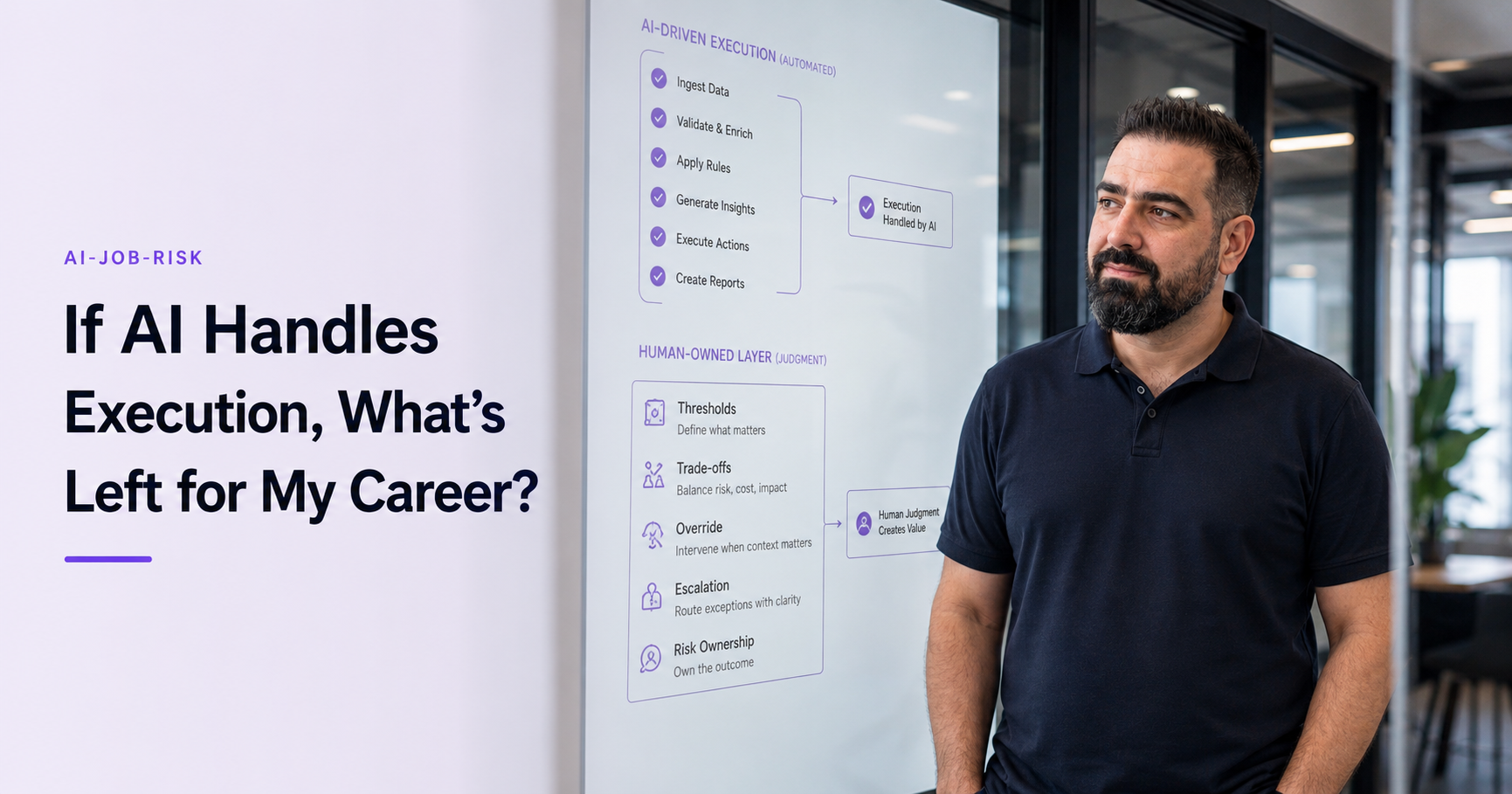
Key takeaways: As AI automates more execution tasks, your career shifts from merely operating tools to applying critical judgment. AI handles the ‘how,’ but it cannot define the ‘why’ or ‘when.’ Focus on developing skills in setting operational thresholds, owning trade-offs between competing outcomes, and knowing precisely when to override or escalate beyond the machine’s output.
“My team runs complex analytics, but AI tools are getting so good at the actual ‘running’ part. What does that mean for my career? If AI handles execution, what’s left for me to do?” This question lands in my inbox almost weekly, echoing a deep, uncomfortable tension across industries.
The short answer: The future of your career lies in the spaces beyond execution—in the realm of judgment. AI excels at processing vast data and executing predefined rules. It is a highly capable machine operator. What it lacks is the human capacity to set the parameters for those rules, to weigh subjective trade-offs, and to own the ultimate risk when those rules fail.
Consider a real-time fraud detection system. An AI model flags 0.5% of transactions as high risk. In the past, an analyst might manually review these alerts, verifying details by cross-referencing databases or customer records. This was execution, often tool-driven. Now, AI can automate much of this review and even block transactions.
A tool operator might simply monitor the queue and ensure the AI runs. A judgment-focused professional, however, operates at a different altitude. They ask: Is 0.5% the optimal threshold for high risk? What is the acceptable cost of a false positive – blocking a legitimate customer and causing frustration – versus the cost of a missed fraud? When do we override an automated block because a known, valuable customer is simply making an unusual purchase while traveling? This isn’t about using the fraud detection tool; it’s about governing its impact, owning the business trade-offs, and knowing when to escalate beyond the model’s confident prediction.
The common mistake is to believe your value comes from mastering the next generation of tools. If your primary skill is expertly navigating a UI, configuring an off-the-shelf model, or generating reports from an AI’s output, you’re competing directly with increasingly sophisticated automation. You become an advanced button-pusher, albeit with smart buttons.
Stronger operators don’t just use AI; they define its boundaries. They own the outcomes when the AI is wrong. They design the human-AI interaction to maximize business value and minimize loss. They are the ones who articulate the nuanced definition of “risk” or “opportunity” for the AI to process. They set the thresholds, understand the financial and reputational impacts of over- and under-alerting, and establish clear escalation paths for situations the AI cannot handle. They don’t run the tool; they calibrate the entire system and hold ultimate accountability.
This week, identify one automated process in your domain. Pinpoint the last human decision point where someone could intervene, change a parameter, or override a recommendation. Ask yourself: who truly owns the risk if that decision, or lack thereof, goes wrong? That owner is exercising judgment, not just executing. Seek to be that owner, and build your career around that accountability.
If you want to see where your own work is exposed, take the AI Job Risk Assessment.
For the full thesis on why AI changes the skill floor, see AI Job Risk. And for a deeper look at how analytics roles are splitting into tool operators vs. decision shapers, read Analytics Jobs Will Split in Two.