Reporting Is Not Intelligence: Stop Decorating Dashboards, Start Triggering Action
Another Tuesday. Another dashboard review. Your team just presented 20 slides of ‘what happened.’ Pretty charts, green numbers, maybe a red outlier. So what?
Reporting Is Not Intelligence
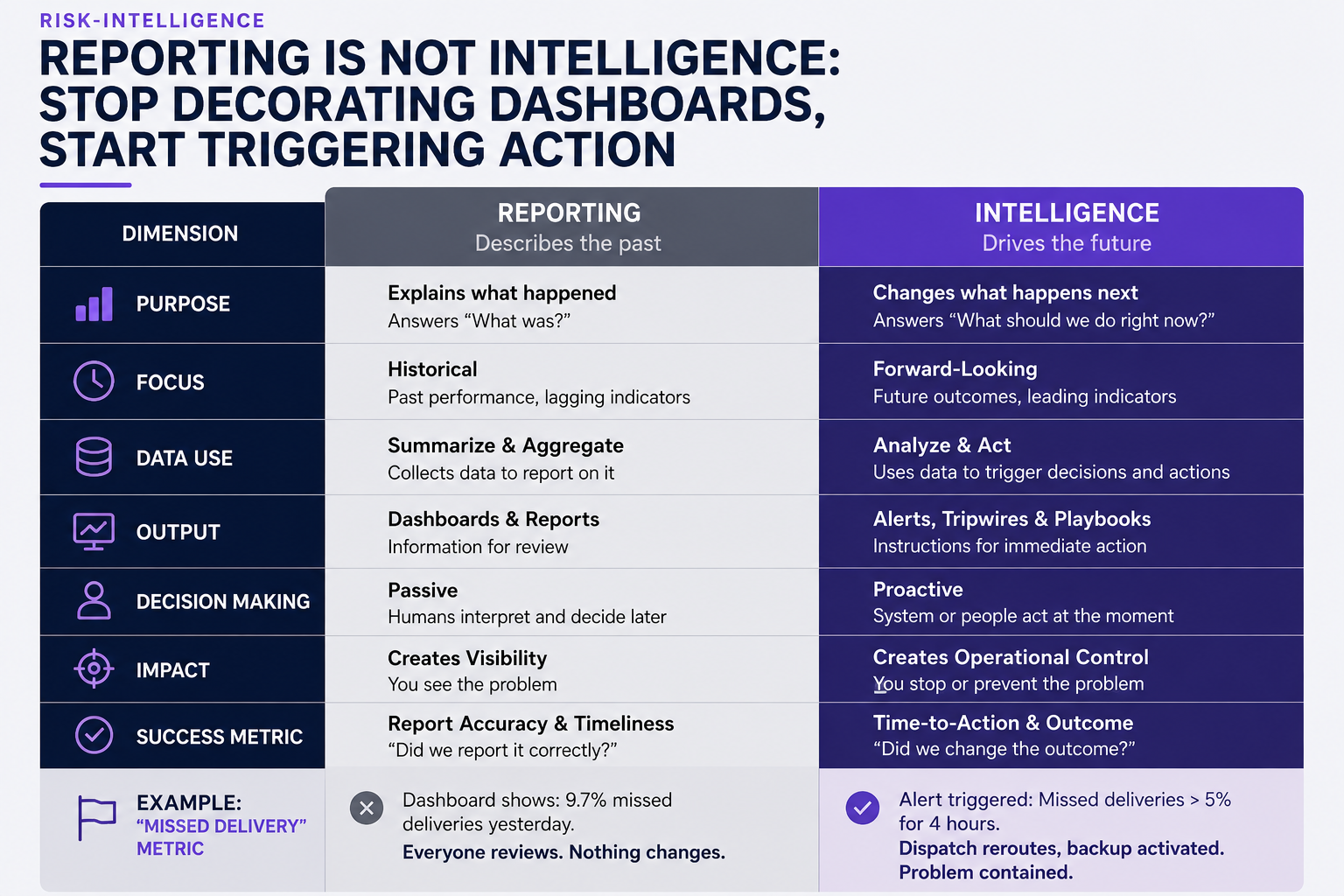
Reporting delivers descriptive summaries: what sales were, how many tickets closed. Intelligence applies predictive foresight and prescriptive action to that data. It uses insights to trigger a specific change in operations before a loss becomes systemic, turning metrics into immediate operational commands.
Most companies drown in reporting. They confuse visibility with action. They build complex dashboards that show a pretty picture of the past, then wonder why nothing fundamentally improves. It’s digital noise, a static radar display when you need dynamic threat detection. We create more reports, more dashboards, assuming more information equals better decisions. It doesn’t. This endless cycle of reporting without action is a core reason why so many data teams struggle to prove their value. They’re building meticulous records of yesterday’s failures while tomorrow’s problems are already kicking down the door. Reporting is not intelligence.
What Happens When Metrics Are Decoration
What happens when metrics are just decoration? You waste time. You miss critical shifts. Your competitors, or market dynamics, move faster. Your people get fatigued by information that demands nothing of them. A 2022 survey by NewVantage Partners found that 92.2% of firms have not yet established a data culture, often because data isn’t driving action or change. NewVantage Partners 2022 Data and AI Leadership Executive Survey
Take “Zenith Logistics,” for instance. Their BI team built a stunning dashboard tracking missed delivery windows. It was updated hourly. Beautiful. It showed what happened (9.7% misses yesterday), not what to do next. Management reviewed the “missed deliveries” chart every morning, nodding sagely. Then they moved on. No automated trigger to re-route drivers, no alert to pre-empt traffic jams, no forced-action escalation. They just watched the number tick up, day after day. They paid consultants millions to report on the problem. They never paid to fix the operational gap, only to document it meticulously.
Build Tripwires, Not Just Charts
Stop building reports that don’t come with an action trigger. Implement “tripwires.” For every critical metric, define the threshold that demands an immediate decision, and outline who makes that decision. For Zenith Logistics, it meant:
- Threshold: If ‘Missed Delivery Window’ for any regional hub exceeds 5% in a rolling 4-hour period.
- Trigger: Automated alert to regional dispatch supervisor and local operations lead.
- Action: Supervisor immediately pulls up driver routes, identifies bottlenecks, reroutes, or calls for backup. Operations lead activates a pre-approved contingency plan for that region.
- Accountability: If the threshold is hit and no action is taken within 15 minutes, the next level of management is auto-alerted.
This isn’t just data. This is AI & Decision Operations. It’s turning signal into an operational command.
Here’s the stark difference:
| Reporting | Intelligence |
|---|---|
| Explains what happened | Changes what happens next |
| Describes current state | Predicts future state, prescribes action |
| Focuses on historical data & trends | Focuses on real-time triggers & interventions |
| “Here’s the problem.” | “Here’s what you do, right now, to prevent X.” |
| Creates visibility | Creates operational control |
So, are your metrics guiding active decisions, or are they just a detailed history of your organization’s slow decline?
If this resonates, I write about this every week. Subscribe to The Second Mind — Join 1,000+ operators who use this intelligence to shorten their signal-to-action time.