Is Your Operating Model Ready for AI? Ask This One Question First
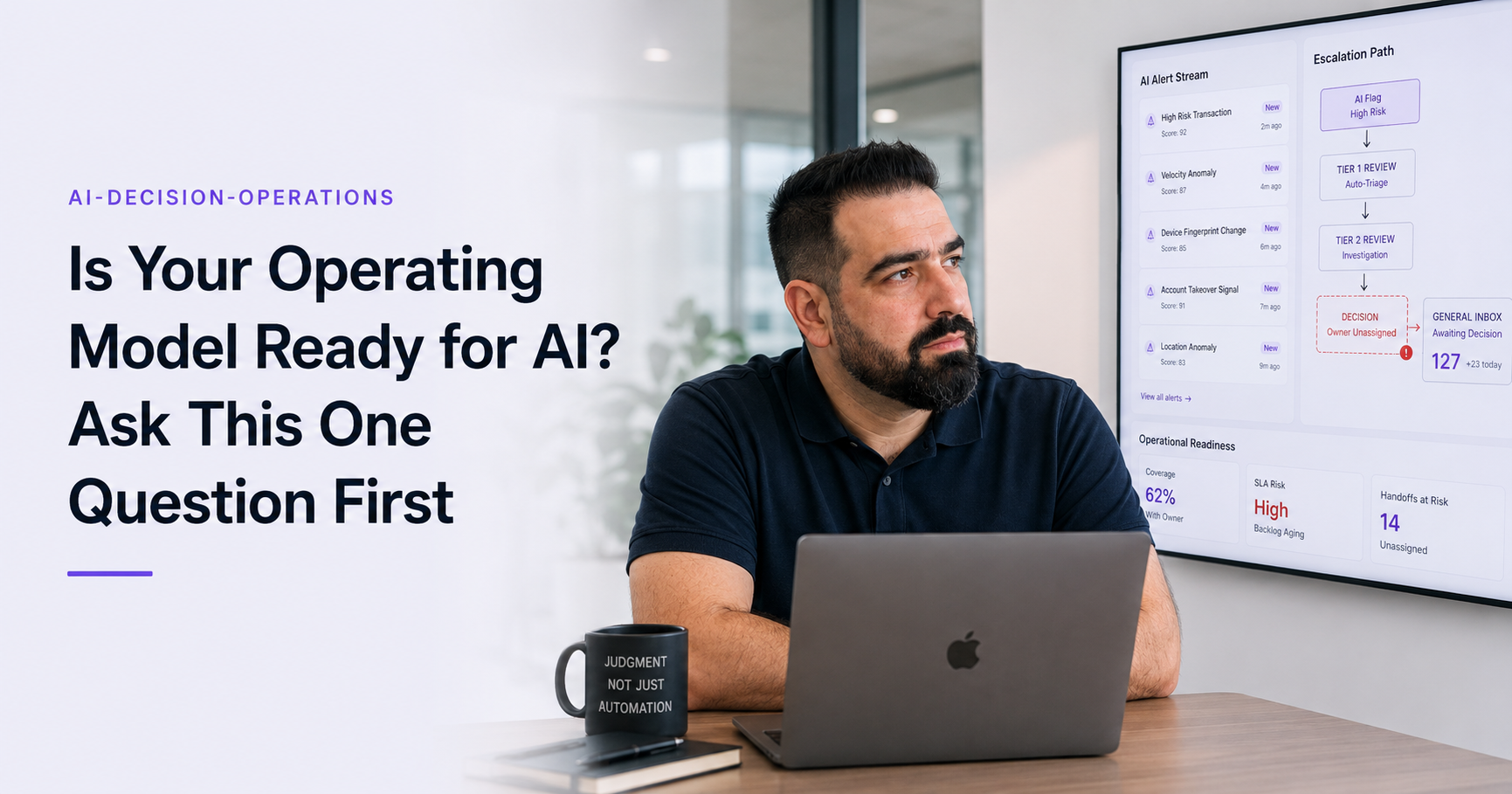
Key takeaways: AI doesn’t automatically improve operations; it highlights existing weaknesses at speed. To extract real value, you must first pre-wire clear decision ownership and escalation paths. Your operating model needs to be proactive, not reactive, to the insights AI delivers.
You’re investing heavily in AI models, expecting them to streamline operations, cut costs, or catch risks faster. But after deployment, do you find yourself with more alerts, more reports, and still the same losses? The common mistake is believing AI will magically fix a messy process.
It won’t. AI models expose the rot in your operating model, but they don’t repair it. They turn unclear ownership, slow escalation, and broken workflows into undeniable, high-volume problems that can overwhelm your teams.
Imagine an AI model designed to detect subtle fraud patterns in real-time. It flags 10 suspicious transactions an hour, sending alerts to a general inbox. A junior analyst reviews a few, unsure if they have authority to freeze an account. They escalate to their manager, who’s in meetings. The alert sits, waiting. By the time a decision is made hours later, the fraudulent transactions have cleared, or the opportunity for intervention has passed. The AI worked perfectly, delivering timely, accurate signals, but the operation failed. The model exposed a critical decision-making gap, not solved it.
The mistake isn’t with the AI, it’s deploying powerful AI into a reactive operating model. You’re building a Formula 1 engine and putting it into a car without a steering wheel or brakes. Many teams hyper-focus on model accuracy, data pipelines, and scalable infrastructure. They neglect the crucial “last mile” of decision execution, assuming the humans will just figure it out. This isn’t an AI problem; it’s an operational readiness problem that AI will expose at scale.
Stronger operators recognize that AI’s true value isn’t in its detection capabilities alone, but in its decision enablement. Before they even consider deploying a model, they ask a critical question: “For every output this AI could generate, who is pre-authorized to act, and what are their specific triggers and boundaries?” This question forces a shift from reactive problem-solving to proactive operational design.
This leads to a practical decision rule: Do not deploy an AI model until a specific owner is assigned for every potential signal, with clear authority and escalation paths defined before the model goes live.
This means having a pre-agreed playbook for every alert type and scenario the AI might flag. It requires defining clear thresholds where an automatic action is taken versus where human review is mandatory. It means empowering your frontline operators with the agency to act – to freeze an account, block a transaction, or trigger a specific human investigation – without needing a meeting for every single instance. This isn’t about giving away unchecked power; it’s about designing controls that are hard-coded into the workflow, providing clear guardrails and defined limits within which rapid decisions can be made. You’re building decision muscles before the AI starts exercising them, not hoping they develop under pressure.
To apply this rule this week, take one AI model you are currently deploying or planning to deploy. Map out three potential outputs it could generate. For each output, identify the specific individual or team explicitly responsible for acting. Then, define their exact decision authority: what can they do, under what conditions, and what is the precise escalation path if a situation falls outside their scope? If you can’t clearly draw that line and communicate it to the owner, stop. Your operation isn’t ready, and your AI will only highlight that fact faster.
Unclear decision paths are the silent killers of operational efficiency. If you’re struggling to translate AI insights into real impact, join my newsletter for more practical strategies on building decision-ready operations.
For the full thesis behind this argument, see AI & Decision Operations. And for a detailed breakdown of how unclear escalation paths kill AI projects, read Why Your AI Project Fails When Nobody Owns the Escalation Path.