Why Your AI Project Fails When Nobody Owns the Escalation Path
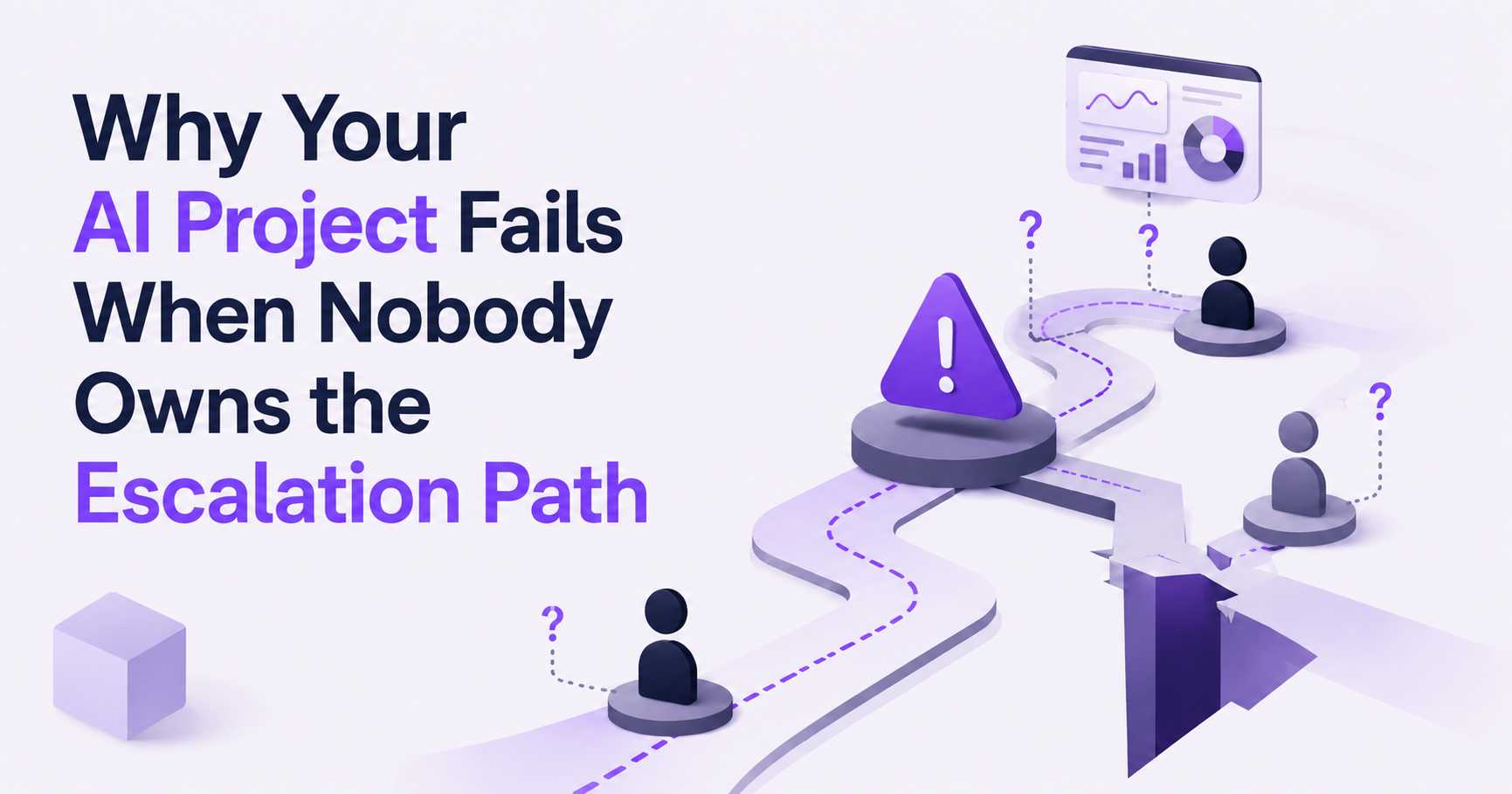
I once sat in a weekly operational review where an anomaly detection system, freshly deployed and much lauded, flagged a suspicious transaction pattern. The model’s accuracy score was impeccable – 98%, according to the data science lead. Everyone nodded. Then a director asked, “So, what exactly happens next with this specific alert?” The room went quiet. The data scientist shrugged, “It triggers an alert in the system dashboard.” The operations manager, who was just there to review last week’s metrics, looked at the head of risk. The head of risk looked at legal. Legal looked uncomfortable. The alert was real, critical, and nobody owned the next step.
The prevailing wisdom is that AI will make our operations smarter, faster, and more efficient. Companies pour resources into building sophisticated models, predicting everything from customer churn to equipment failure. They chase accuracy percentages and boast about model performance. They think the hard part is training the algorithm to see the signal in the noise. That is the common view, and it is incomplete.
AI doesn’t repair unclear ownership, slow escalation, or broken workflows. It exposes them – faster, louder, and at a scale you can’t ignore. The true challenge isn’t the AI’s ability to detect a problem; it’s our organizational inability to define who is responsible for acting on that detection. The best AI teams understand this. They spend 80% of their time on process, not models, because they know a perfect model spitting out alerts into a void is just expensive data art.
Consider a sophisticated AI system built to identify potential supply chain disruptions – a key risk in today’s volatile market. The model analyzes geopolitical events, weather patterns, and supplier financial health, then projects a high probability of delay for a critical component. The alert fires, categorized as “High Severity – Immediate Action Required.” The dashboard glows red. Who receives this alert? A distribution list? An individual? What is their first step? Is there a defined playbook for “High Severity Supply Chain Disruption”? Is there a pre-approved alternative supplier, or a contingency plan that can be immediately activated without a three-day email chain approval process? What’s the decision threshold for pulling the trigger on a costly backup plan? When does it escalate to the executive team, and in what format?
The hidden failure point isn’t in the model’s predictive power, but in the operational gaps that render its output impotent. It’s the moment when the system says, “Here is a problem,” and the organization responds with “Whose job is that, again?” Busy is not the same as protected. If the owner of that next action is unclear, if the escalation path requires approval from three different VPs in three different departments, if there’s no defined workflow for validation or resolution, then the AI is just illuminating the broken plumbing.
Stronger teams operate differently. Before their AI model even enters production, they map out the minimum viable operational system around it. This means defining roles (who owns the alert from receipt to resolution?), establishing clear escalation paths (when does it move from individual to team to leadership?), setting decision thresholds (what data point triggers what predefined action?), and crucially, building a feedback loop for process improvement. They don’t just test the model; they run simulations of process failures. They ask: If the model says X, who does Y, then Z, and how quickly? They recognize that the technology is only as effective as the human systems designed to interpret and act upon its insights. They face the uncomfortable trade-off: slowing down the exciting, public-facing model deployment to painstakingly build the unglamorous, internal operational scaffolding. They invest in the clarity of ownership and action, understanding that an AI system without these is a liability, not an asset.
The dashboard is not the decision. The AI output is not the action. It is merely a sophisticated pointer. Your task, as a leader or professional in this space, is to build the operational architecture that actually translates that pointer into impact. The immediate takeaway is clear: before you greenlight another AI project, map out one critical decision pathway for its output. From detection to resolution, who does what, when, and with what authority? Identify every single handoff, every approval, every required action. If you can’t draw a clear, unambiguous line from alert to resolution, you don’t have an AI solution. You have an AI exposer of operational weakness. Fix the operations first.
For the full thesis on why AI exposes weak operations, see AI & Decision Operations. For a related exploration of how this plays out in real incidents, read Escalate or Eat the Loss. And for the lexicon term behind this failure, see Escalation Debt.