AI Models Don't Repair Operations; They Expose Unclear Escalation Paths
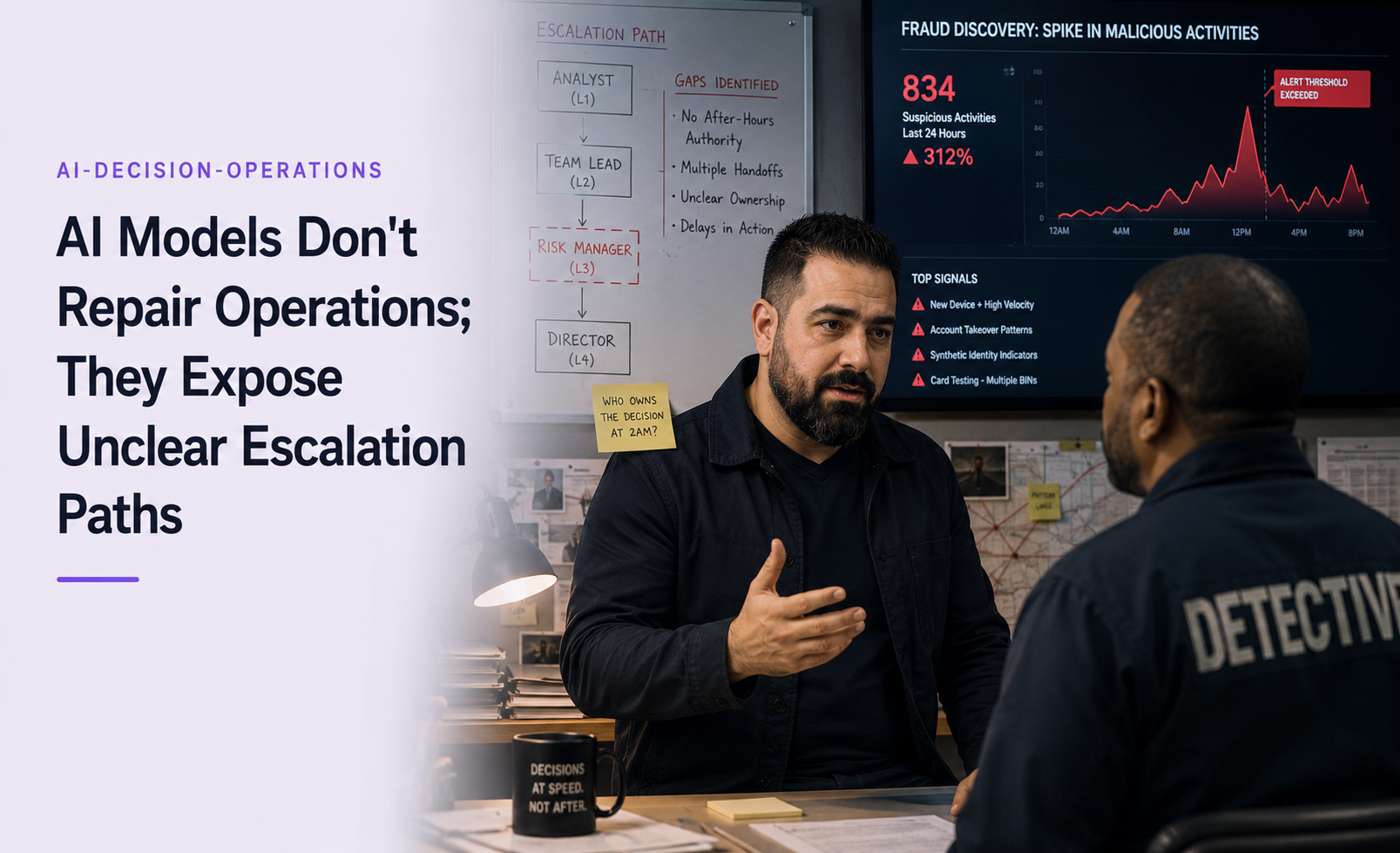
A few months ago, a new fraud detection model went live, a flagship project leveraging deep learning to catch patterns human analysts consistently missed. The initial metrics were compelling: a significant uptick in flagged suspicious transactions, many of which turned out to be genuinely problematic. We had built something genuinely intelligent, a testament to cutting-edge data science. But within weeks, the glowing reports started to fray. The questions began trickling in, then flooding: “What do we do with this type of alert?” “Who needs to approve blocking a high-value account based on this score?” “The model’s threshold is new, does it override the old policy that requires two human reviews?” The model was working, producing clear, high-confidence signals. The operations team, however, was freezing, caught in a paralysis of process.
The prevailing narrative around AI deployment often focuses solely on model accuracy, feature engineering, or infrastructure. There’s a subtle, almost innocent belief that a “smart” system will inherently make operations smarter. That its outputs, by virtue of being data-driven, will automatically translate into efficient action, streamlining processes that were once manual. This overlooks a fundamental truth about operational systems: they are only as effective as the human processes and authorities governing them.
The hard truth, one often sidestepped in boardrooms eager for “AI transformation,” is this: AI doesn’t repair unclear ownership, slow escalation paths, or fundamentally broken workflows. It cannot fill organizational voids or magically imbue frontline teams with decision authority they don’t possess. Instead, AI exposes these weaknesses faster and at a scale no manual process could ever hope to achieve. A model, relentlessly identifying anomalies and demanding immediate attention, acts like a high-pressure stress test, pushing a torrent of precise, often complex signals onto an operational structure that was perhaps only “good enough” for the slower, less defined world that preceded it. It shines an unforgiving light on every undefined handoff and every missing signatory.
Consider that fraud detection model. Before its deployment, analysts would manually review cases based on simpler, more established rules. If something was ambiguous or exceeded their authority, they’d consult a senior analyst, perhaps send an email, or schedule a meeting. The volume was manageable enough that these ad-hoc, often circuitous routes didn’t cripple the system. When the AI went live, it wasn’t just flagging more; it was flagging differently—complex, nuanced cases that didn’t fit neatly into existing playbooks. The model would identify a high-risk transaction in seconds, but the human process to act on it would take hours, or even days. The escalation matrix, if it even existed, was a flowchart from a different era, full of dead ends and “ask your manager” nodes. Losses continued, not because the model failed, but because the decision system was fundamentally broken.
The hidden failure point isn’t about the model’s F1 score; it’s the “decision authority gap.” Teams often focus on “getting the model into production” as the finish line, assuming the job is done once the code is deployed. But production for an AI model means generating signals, and signals demand responses. If the person receiving an AI-generated alert lacks the clear authority to act, or the immediate, pre-defined path to someone who does, then the entire investment in AI becomes a sophisticated alerting system for problems you are not organized to solve. The information arrives, often with urgency, but the power to use it is fragmented, diluted, or simply absent. This is the uncomfortable trade-off: acknowledging that the biggest barrier to AI success isn’t technical complexity, but organizational clarity and empowerment.
Stronger teams understand that deploying an AI model is not merely a technology project, but an operational transformation. They don’t just build models; they redesign the operational muscle around them. While average teams might build the model and then ask operations, “What do you want to do with these alerts?” — creating dashboards showing “model performance” but not “operational impact” — stronger teams operate differently.
Stronger teams start by asking: “What decision needs to be made, by whom, and with what authority, when this model flags X type of event with Y confidence?” They define clear action thresholds, pre-authorize specific responses, and map out immediate, unambiguous escalation paths before the model goes live. They embed decision authority at the lowest possible level, empowering frontline operators with specific, tested playbooks for AI-generated signals. They iterate on the process of response as much as on the model itself, understanding that an accurate signal without an empowered responder is just noise. AI does not remove the need for judgment. It exposes where judgment was missing.
Before you even think about the next AI model, map out the decision pathways for its output. For every potential signal your AI will generate, define precisely who is responsible for the decision, what their authority level is, and what the immediate escalation path looks like. If you cannot answer these questions clearly and succinctly, your operational structure is not ready for the scale and speed of AI. Build the decision system first. The model will only reveal what was already broken.
For the full thesis on this pattern, see AI & Decision Operations. For a practical example of how unclear escalation paths kill AI projects, read Why Your AI Project Fails When Nobody Owns the Escalation Path. And for the lexicon term behind this, see Escalation Debt.