AI Exposure Reveals If Your Senior Operators Are Just Advanced Tool Users
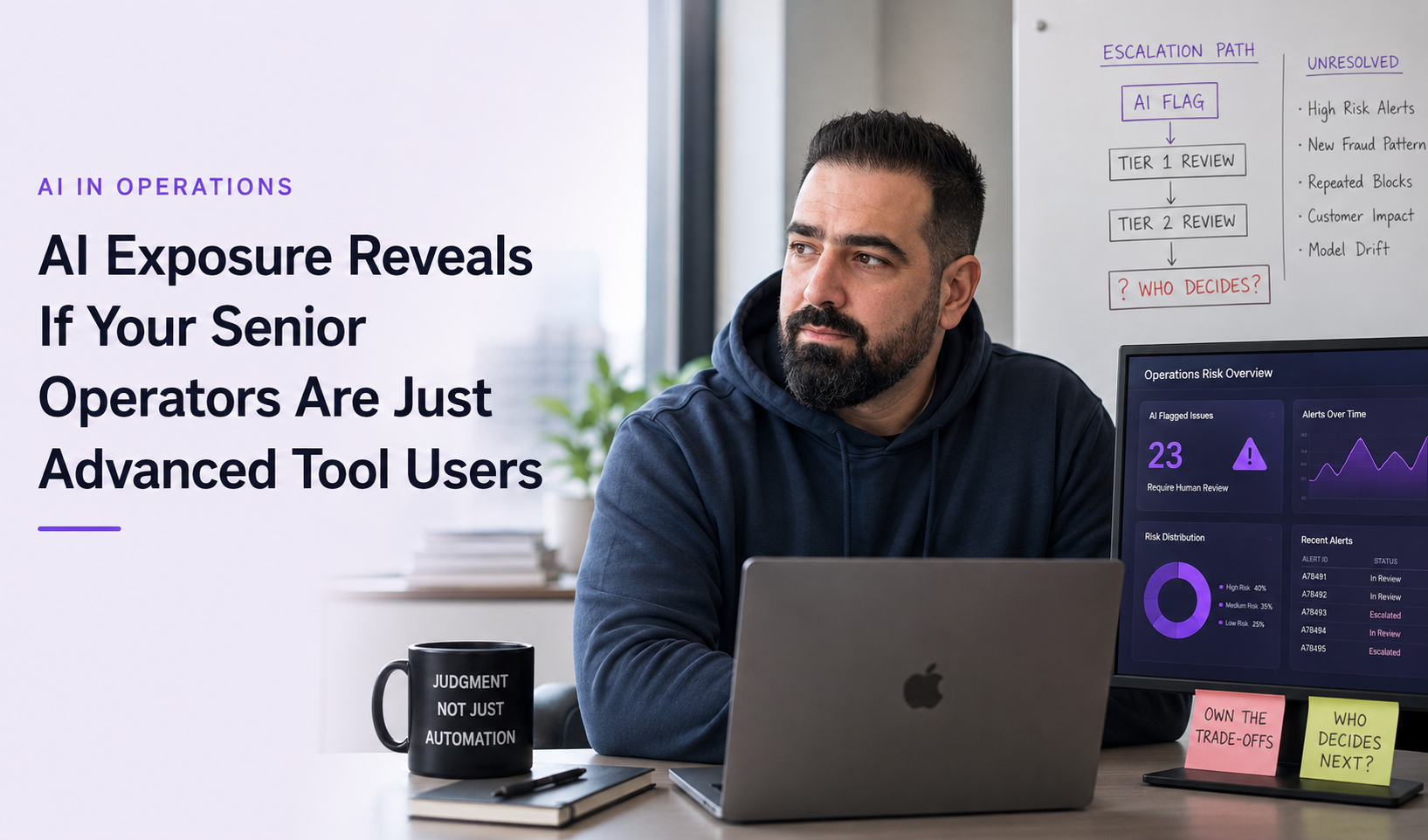
A functional AI system in operations or analytics isn’t just an algorithm. It’s a structured decision engine with clearly defined human interfaces. You build it with distinct layers: the AI performs the routine, high-volume tasks. Humans handle the exceptions, the edge cases, and the consequences.
This structure has fundamentally shifted what it means to be ‘senior’. The skill floor has risen, but not in the way many expect. It’s not about becoming a prompt engineer or a data scientist who can fine-tune LLMs. Those are new tools, and operating tools is still operating tools.
AI takes over the predictable, the repetitive, and even the complex data manipulations that once defined technical ‘seniority’. If your value hinged on knowing arcane Excel functions, mastering SQL joins, or navigating complex dashboards, AI has just made your core contribution obsolete. These are now table stakes, automated or simplified to the point where an intern can achieve similar output with less effort.
The real shift is towards judgment. It’s about setting the thresholds, owning the trade-offs, and knowing precisely when to escalate – and to whom. This isn’t about using the AI; it’s about governing it within a business context. It’s about being accountable for the system’s output, not just the model’s input.
Consider a real-world scenario in fraud detection. A major financial institution deploys an AI model to identify suspicious transactions in real time. The goal is to catch fraud before it impacts customers or the bank’s bottom line.
The system’s basic operation is straightforward: the AI scores transactions for fraud risk. Low scores are approved instantly. High scores are blocked instantly. Transactions falling in the middle — say, between a 30% and 70% probability of fraud — are flagged for human review by a junior analyst. This junior analyst follows a clear script: verify details, contact customer, release or block based on predefined rules.
Here’s where the old definition of ‘senior’ falls short and the new one becomes critical. An old-school senior analyst might excel at building a dashboard to visualize fraud trends, or write advanced SQL queries to analyze false positives. They might even train junior analysts on how to use the fraud detection software more efficiently. But they are still, fundamentally, tool operators, albeit advanced ones.
A truly senior operator in the AI era does something different. They are the ones who set the 30% and 70% probability thresholds in the first place. They understand that lowering the ‘auto-approve’ threshold to 20% might catch more subtle fraud but will massively increase false positives, inconveniencing legitimate customers and overwhelming the human review team. Raising the ‘auto-block’ threshold to 80% might reduce false positives but risks letting more actual fraud slip through.
This is the uncomfortable trade-off they own: the cost of customer friction (false positives) versus the cost of fraud losses (false negatives). There’s no perfect number. The senior operator signs off on this operational risk and is accountable for the financial and reputational impact. They decide when the model needs retraining, not just because a data scientist says so, but because the business outcome is failing.
They define the escalation path. If the AI starts flagging a completely new type of scam, or if a significant legitimate customer is repeatedly being blocked, the junior analyst doesn’t just escalate to another analyst. They escalate to the senior operator who has the authority to temporarily override the system, convene stakeholders, and decide if a strategic change to the model or process is required. This isn’t about technical troubleshooting; it’s about owning a business problem exacerbated by the AI.
Strong teams understand this distinction. They don’t just deploy AI models; they design the entire system of work around them. Their ‘senior’ talent isn’t measured by tool mastery but by their capacity for judgment. They empower these individuals with clear decision-making authority and hold them accountable for the net business impact, not just the AI’s accuracy metrics in isolation.
Average teams, on the other hand, treat AI as a magic box. They expect the AI to solve the problem, and their senior staff focus on optimizing the AI itself, rather than owning the full end-to-end operational outcome. They lack defined escalation paths beyond technical support, leading to paralysis when the AI encounters novelty.
AI has not made hard decisions go away. It has just accelerated the pace at which those decisions must be made and mercilessly exposed who is actually capable of making them. Your ‘senior’ talent now faces a clear choice: master the tools, or master the judgment required to govern the tools and own the trade-offs.
Will you invest in senior operators who can expertly run the machines, or those who can skillfully navigate the unpredictable human and business consequences of the machines’ output?
For the full thesis on why AI raises the skill floor, see AI Job Risk. For the lexicon term behind this exposure, see Tool Operator Trap. And if you want to understand the broader split between tool operators and decision shapers, read Analytics Jobs Will Split in Two.