Build AI Operations That Bend Under Load: Give Signals Authority or Pay for Noise
Models surface risk faster. Only authority, budgets, and fallback modes prevent alert floods from turning into losses.
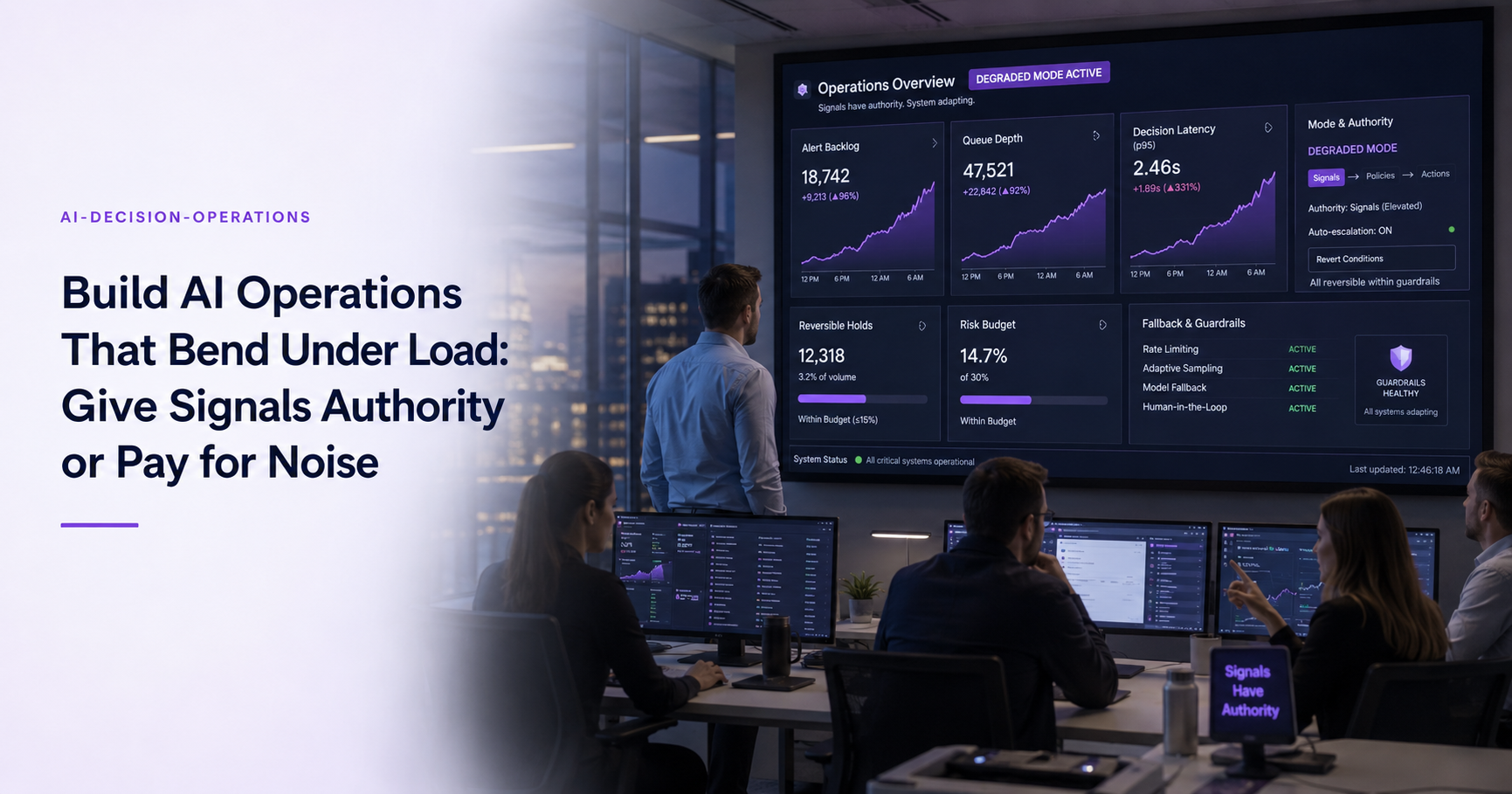
Most teams believe better models and more alerts make them safer. I disagree. If your decision path is slow or ownerless, AI just multiplies the pain and the bill.
AI doesn’t fix unclear ownership. It exposes it at scale. A flood of high-signal alerts without authority to act is not protection; it’s a liability. Signals need the right to trigger action. Detection without decision power is expensive noise.
Graceful degradation is the design goal. When pressure spikes, your system should keep moving at reduced fidelity, with bounded loss, not freeze behind an approval chain. That requires pre-committed authority, risk budgets, and mode switches tied to decision latency, not model performance.
A concrete day: In 2023, a marketplace I worked with got hit by a promo-abuse ring that turned into card testing. The model flagged a sharp spike in new-buyer redemptions at 9:17 a.m. Triage spun up cases by 9:28. Good detection. Then it stalled.
Decisions required three approvals for payout holds and account suspensions. Median hop time between approvers was 12–18 minutes. By 10:30, backlog was 340 cases. Ops could clear about 50/hour at best; the ring was adding ~140/hour. By noon, backlog hit ~900, with decision latency averaging 70 minutes per case.
Meanwhile, attackers moved. Average order size was $58. Payment volume through flagged accounts grew at ~$80k/hour after 11:00. Payouts from the morning processed at 2:00 p.m. Legal wanted sign-off to delay transfers. By 5:30 p.m., leadership finally approved a sweeping payout hold and bulk suspensions. That single day cost roughly mid-six figures in chargebacks and credits. Same model, same data — the difference was a seven-hour approval chain and no pre-authorized fallback mode.
Here’s the hidden cost when you get this wrong:
- Queue math beats model precision. At 140 new cases/hour and 50 decisions/hour, you fall behind by 90/hour. Every hour you wait, the next hour is worse. Loss compounds while you debate.
- Reversible actions arrive too late to be reversible. A payout hold at 10:00 a.m. costs you angry sellers. The same hold at 5:30 p.m. costs you their money.
- People burn out. Three approvers cycling Slack for hours is not redundancy; it’s drag. Tomorrow, they will ignore the next spike longer.
Design AI-assisted operations to degrade gracefully under pressure:
1) Tie authority to decision latency, not to seniority. Set an SLO for detection-to-decision (e.g., 15 minutes for payout holds on new entities; 60 minutes for permanent bans). If median latency is breached for 10 minutes, switch modes automatically: frontline can place reversible holds within a pre-committed budget without further approvals. Latency, not vibe, flips the switch.
2) Budget authority, not opinions. Give each shift a risk budget (e.g., $250k/day of holds or 1,500 auto-flags) with clear action classes and logs. When the budget is exhausted, the next tier gets paged with a 10-minute timer. If they don’t respond, the system maintains degraded mode. No open-ended waiting allowed.
3) Separate reversible from irreversible actions. Default to reversible blocks (payout holds, credit disables, rate limits) in degraded mode. Make irreversible steps (account bans, inventory removals) require a single on-call owner, not three. Reversibility buys you time and keeps the blast radius small.
4) Route by decision, not by model. Stop shoving every alert to a general queue. Group by entity and intended action path. One case, one owner, one action. Collapse duplicates and burst-limit near-identical signals to preserve human focus in a surge.
5) Pre-commit escalation paths with timers. Every alert class names a DRI with a backup, both with paging. Timers are hard stops: at T+10 minutes with no response, the system executes the reversible action within budget. Slack consensus isn’t a control.
6) Publish loss envelopes and make trade-offs explicit. Decide in calm weather how much false-positive friction you accept to buy 2 hours in a storm. Document thresholds to raise or lower when backlog hits X or approval latency crosses Y. Operators should move toggles with confidence, not ask permission mid-crisis.
7) Practice failure. Run monthly stress drills. Double alert volume for an hour. Kill an approver mid-incident. Measure detection-to-decision time, not model AUC. If your timers don’t trigger degraded mode automatically, you don’t have a system — you have hope.
What strong teams do differently:
- They measure the right latency. Not just model runtime, but time-to-authorized-action. That metric is on the exec dashboard.
- They reward speed with guardrails. Frontline staff are trusted with budgets and praised for safe, fast reversibility under pressure.
- They compress ownership. One person can act. Everyone else is an advisor by default, not a required signature.
- They design for undo. Customer recovery processes, one-click reversals, and apology credits are funded upfront to offset false positives.
Average teams tune their models and study dashboards. Strong teams tune their decision path and pre-wire authority to the clock.
The uncomfortable trade-off: you either accept more reversible false positives during a surge, or you accept compounding losses while you seek consensus. You can’t have both perfect accuracy and fast control when the system is on fire. Choose the error you’re willing to pay for in advance and encode it in your modes.
If your next spike hits at 9:17 a.m., do you let the model act within a risk budget by 9:30, or do you wait for approvals and fund the attackers until 5:30?
For the full thesis on why signals need authority, see AI & Decision Operations. For a practical framework on picking cutoffs under pressure, read AI Won’t Reward More Tools. And for the lexicon term behind this, see Decision Latency.