AI Will Bypass the Middle Layer: If You Don’t Set Thresholds and Own Escalations, You’re Replaceable
AI doesn’t eat entry-level work first. It eats the middle where people push tools but dodge trade-offs.
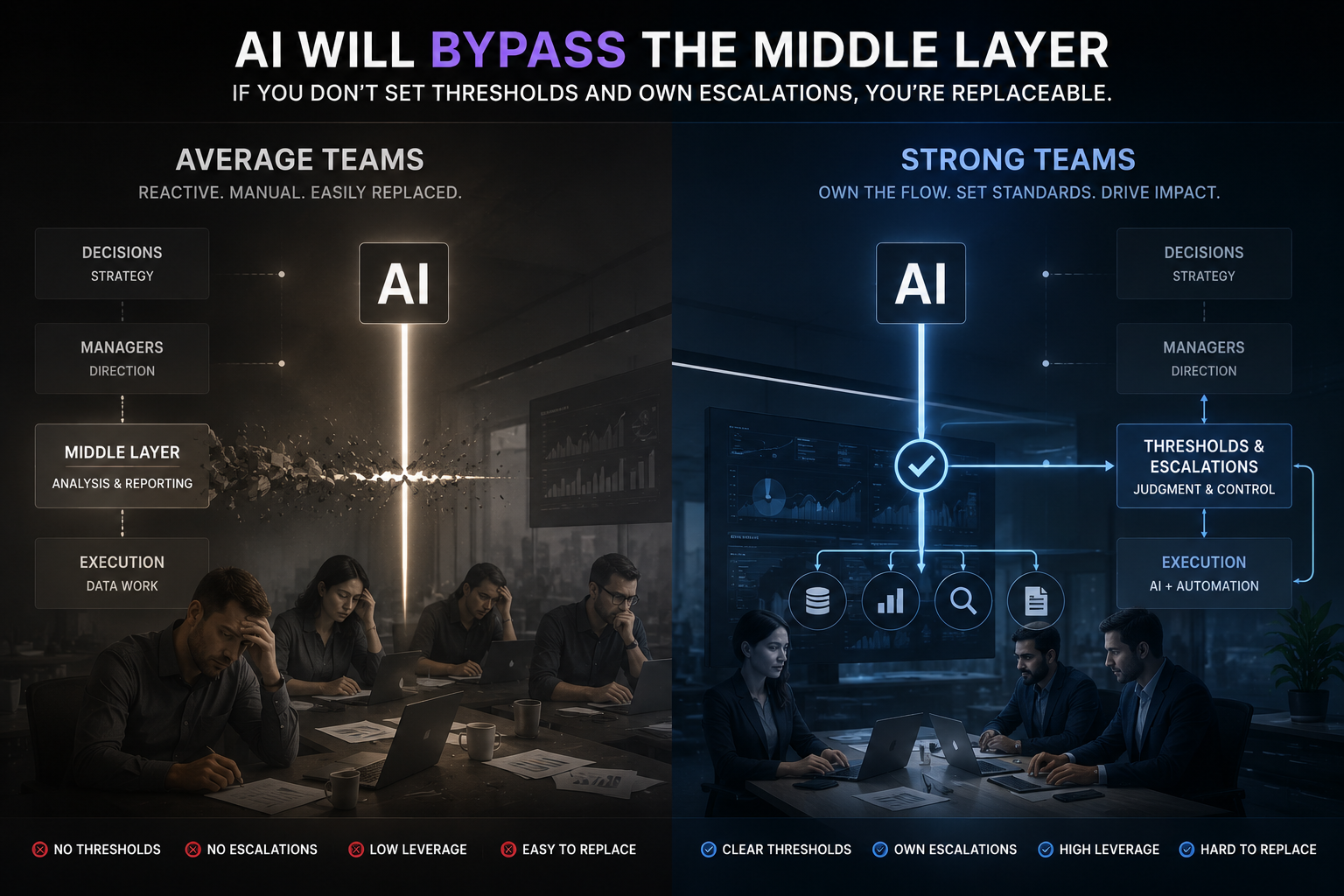
Most people believe AI will wipe out junior roles first and “level up” the middle. That’s backwards. AI erases the middle layer that lives on tools, status updates, and templated analysis. What’s left is judgment: setting thresholds, taking sides on trade-offs, and deciding when to escalate.
Why? Because AI collapses the cost of getting to a decent draft of anything—SQL, a model, a summary, a dashboard, a slide. It does not collapse the cost of deciding. The person who sets the threshold and signs for the impact is the one management keeps. Everyone else becomes a pass-through for machine output.
Here’s what that looks like when it’s real, not theoretical.
Last August, a national apparel marketplace hit a spike in returns fraud right before back-to-school. By 3:12 p.m. Friday, CS tickets jumped 40% in ZIP codes tied to a TikTok “free outfit” loop exploiting gift card refunds. The detection model lit up, precision dipped, and Slack filled with screenshots of charts.
The average analytics pod pulled a Looker explore, argued about AUC drift, and promised a “Monday readout.” They asked the vendor for new features. They wrote a paragraph about data gaps. Nobody named a threshold change. Nobody volunteered to own the customer blowback.
One ops lead, Marta, did the opposite. She set an immediate 24-hour hold on gift-card refunds for three high-risk cohorts, dropped auto-approve from $75 to $40 for new accounts, and required a second-factor check for PO box returns. She knew it would hit about 2% of good customers that weekend. She got VP sign-off at 4:02 p.m., posted the change log, staffed an on-call queue, and owned the fallout by name.
Losses halved by Sunday. Support backlog spiked nine hours. Marketing yelled. Finance thanked her. She chose, she documented the trade-off, and she took heat. That’s judgment. AI didn’t do it. A mid-level “tool operator” couldn’t do it because they were never asked to hold the steering wheel.
This is why the middle layer is most exposed. Their value has been turning signals into nicer signals—queries into charts, model outputs into decks, alerts into meetings. AI can do that in seconds. What AI still can’t do is decide whose pain you will accept today to avoid worse pain tomorrow.
Let’s get specific about the gap between average and strong teams.
Average teams:
- Translate model outputs into dashboards and weekly updates.
- Talk about precision/recall and ask for more data “before we act.”
- Escalate without a recommendation: “Raising awareness.”
- Hide behind tools: “The vendor doesn’t support that yet,” “We need a new feature.”
- Treat false positives as somebody else’s problem (Support, Marketing).
- Measure accuracy and call it success while money leaks.
Strong teams:
- Pre-commit to loss and friction budgets by segment. Write the numbers down.
- Define explicit thresholds, who can change them, and the time window to act.
- Run an on-call with authority: a human flips the switch; a human signs the risk.
- Ship guardrails: kill switches, canary cohorts, rollback plans.
- Escalate with a position: “Set refund hold to 24 hours for cohorts A/B. Expect 1.5–2.0% extra friction. Saves ~$X this weekend. I’ll own Support load.”
- Close the loop on outcomes with money, not model metrics.
Notice the verbs. Average teams describe and defer. Strong teams decide and accept.
Conventional wisdom says “AI will amplify the middle” because it makes them faster. Sure—it makes everyone faster at the easy parts. Drafting the query. Summarizing the log. Explaining the model. That’s exactly why this layer is exposed. Their tasks compress to near-zero cost, so managers skip them to the person who can pull the lever.
The uncomfortable trade-off you have to face is simple: to reduce real loss quickly, you will sometimes hurt good customers. If you can’t live with that, you’re not in control—you’re adjacent to control. In a spike, there’s no clean room where both loss and friction go down on command. You pick which curve you’ll move and by how much, and you put your name on it.
AI makes this starker. LLMs will propose thresholds. Auto-remediation will ship pull requests. Monitoring will narrate incidents. The only question left is: who owns the irreversible changes and the blowback? That’s a smaller group than most org charts admit.
If you lead a team and don’t want to be automated out of relevance, move the work from tools to thresholds:
- Convert “insights” to operating limits. What are the max/mins you will enforce by segment? Write the numbers.
- Assign names to levers. Who can move refund holds, auth scores, blocklists, payout delays? During which hours? With what guardrails?
- Budget errors ahead of time. How much false positive friction can you spend this month to buy down loss? Who absorbs the NPS hit?
- Practice escalations. Two-paragraph memos: what changed, what we’ll do, expected cost, rollback. No slides.
- Pay down decision latency. If it takes a week to align, AI will outpace you and ship the wrong thing on autopilot.
If you’re an individual contributor stuck in the middle layer, stop polishing dashboards and start volunteering for hard calls. Ask to be the named owner for one lever with real cost. Learn what Support hears at 2 a.m. Sit in finance close and hear how loss hits P&L. Your safety is not becoming a better prompt engineer. Your safety is owning a threshold and proving you can move it responsibly.
The entry level survives by doing what AI still can’t reach cheaply: fieldwork, messy data capture, human conversations, on-the-ground checks. The senior level survives by carrying decision risk. The middle that only formats signals gets squeezed from both sides.
In the next incident, when the model lights up, will you flip the threshold and sign your name to the trade-off, or forward a screenshot and hope someone else decides?
For the full thesis on AI and the skill floor, see AI Job Risk. For a framework to evaluate where your own work stands, take the AI Job Risk Assessment. And for the lexicon term behind this trap, see Tool Operator Trap.