Your Job Is Not AI-Proof Because You Use AI
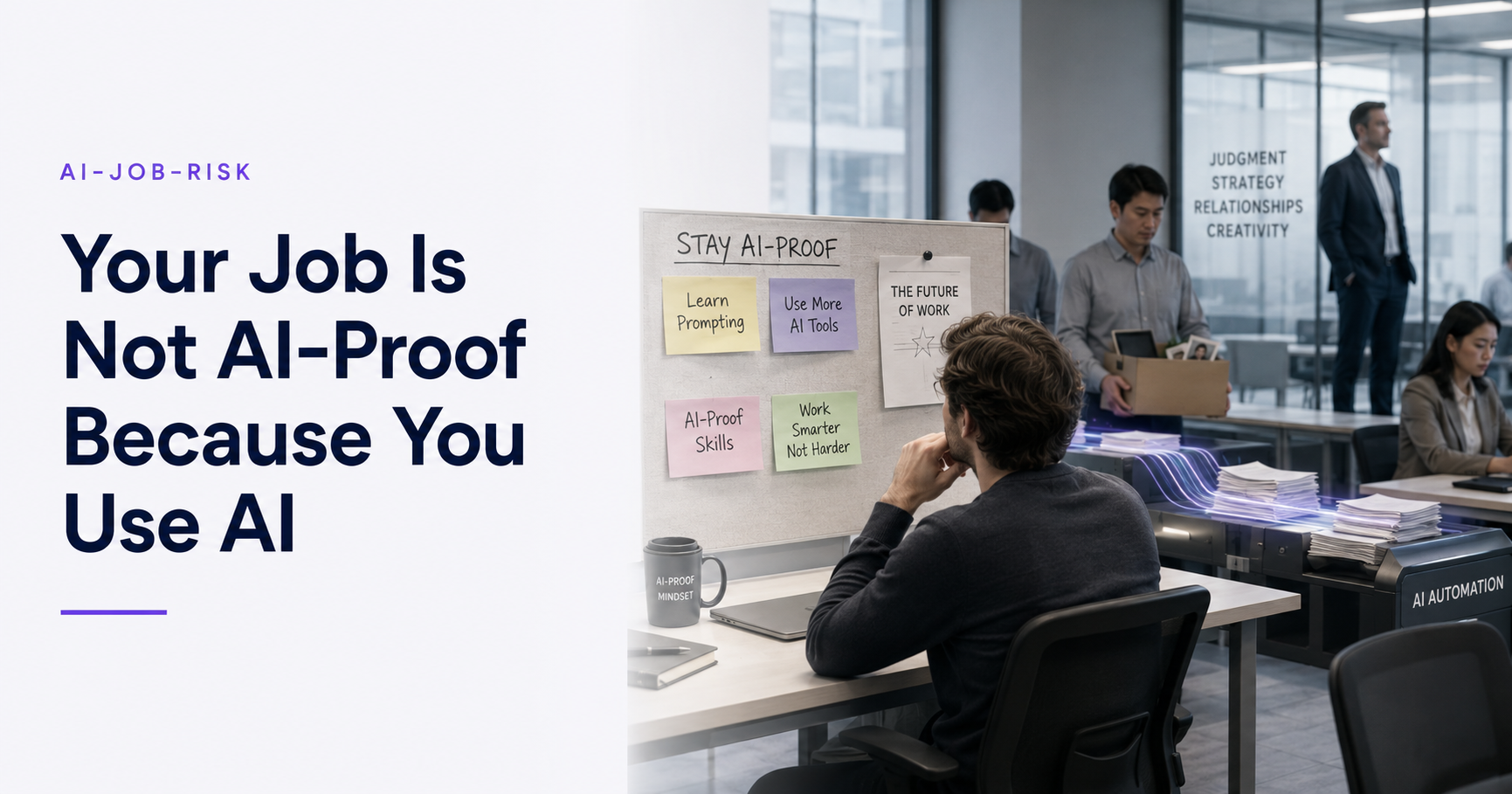
The “AI proof career” advice you’re hearing is mostly garbage. It’s designed to make you feel safe, not prepare you for the brutal efficiency AI is bringing to the workplace.
The greatest AI job risk isn’t about AI replacing specific tasks; it’s about AI exposing the lack of judgment in roles that only operate tools. Your career becomes AI-proof not by learning how to use AI, but by mastering the judgment required to set thresholds, own trade-offs, and know when to escalate.
Most advice tells you to “learn to prompt” or “upskill in AI tools.” That’s like telling a soldier to master cleaning their rifle when the enemy has invented radar systems. It’s necessary, sure, but entirely insufficient. What happens when the tool itself is obsolete, or when the decisions it enables are poorly defined? We’ve allowed a bizarre fantasy to take hold: that merely being busy with information processing equates to value. AI Theater at its finest.
The Illusion of “AI Proof” Skills
The market for “AI career advice” is booming, but most of it is selling comfort, not competence. They tell you to become a prompt engineer. Great. For how long? If your entire value comes from knowing the precise syntax to get an LLM to generate a report, what happens when the LLM gets better at interpreting natural language? Or when the company decides the report isn’t even needed, thanks to real-time signals?
The truth is, AI raises the skill floor. It doesn’t eliminate work; it eliminates easy work, repetitive work, and work that requires no actual decision-making. If your job primarily involves moving data from one place to another, summarizing findings without owning the consequence, or creating dashboards nobody acts on, you’re on a digital battlefield with rapidly changing terrain.
Organizations, especially large ones, are laden with individuals who perform tasks without owning the outcomes. Think of “analysts” who build dashboards showing a problem, but never decide what to do about it. Or “operations specialists” who follow a process script, but can’t articulate why the threshold is set at 100 instead of 50. AI will automate away the tool operator layer, leaving a gaping hole for those who can’t step up to judgment. You’ll be left without a chair when the music stops, or worse, managing an automated process you don’t actually understand the risk profile of. This often leads to Escalation Debt as the automated systems flag issues no one is empowered to resolve quickly.
From Operator to Owner
To survive and thrive in this shift, you must transition from a tool operator to an owner of decisions.
Here’s the difference:
| Tool Operator | Decision Owner |
|---|---|
| Follows existing thresholds/rules | Sets and defends thresholds; understands trade-offs |
| Summarizes findings for others to act | Owns the action and its consequences |
| Operates software to generate reports/data | Designs operational controls that act |
| Asks “What does the data say?” | Asks “What decision do we make given this data?” |
| Views AI as a faster way to do old tasks | Views AI as an accelerant for real-time judgment |
Let’s take “Sarah,” a compliance analyst at “Evergreen Financial.” For years, her job was to pull transaction data, run it through pre-defined rules in a system, and flag anything above a certain dollar amount for review. She was excellent at operating the tool. Now, an AI system does this 10x faster and flags nuance the old rules missed. Sarah’s old job is gone. Her new value comes from working with legal counsel to define new, dynamic thresholds, understanding the risk tolerance for the bank, and deciding when to escalate directly to law enforcement versus a manual review. She’s not just using the AI; she’s designing its operational parameters and owning the critical trade-offs. This is moving from information worker to AI & Decision Operations.
A report by PwC found that “AI adoption is creating a significant ‘upskilling emergency’” for 69% of global employees, highlighting that “employees who only operate tools are most at risk of having tasks automated away.” PwC Global Workforce Hopes and Fears Survey 2023 underlines this exact point: the shift isn’t about AI eliminating jobs entirely, but rapidly changing what constitutes value in a role.
When AI automates your current output, will your organization still need your expertise to make the actual decisions, or will they simply need a better tool?
If this resonates, I write about this every week. Subscribe to The Second Mind — Weekly writing on AI, risk, and decisions. How to use AI in operations and risk — and how AI is reshaping the skills that matter at work.