AI Job Risk for Marketing Jobs: Which Roles Survive and Why
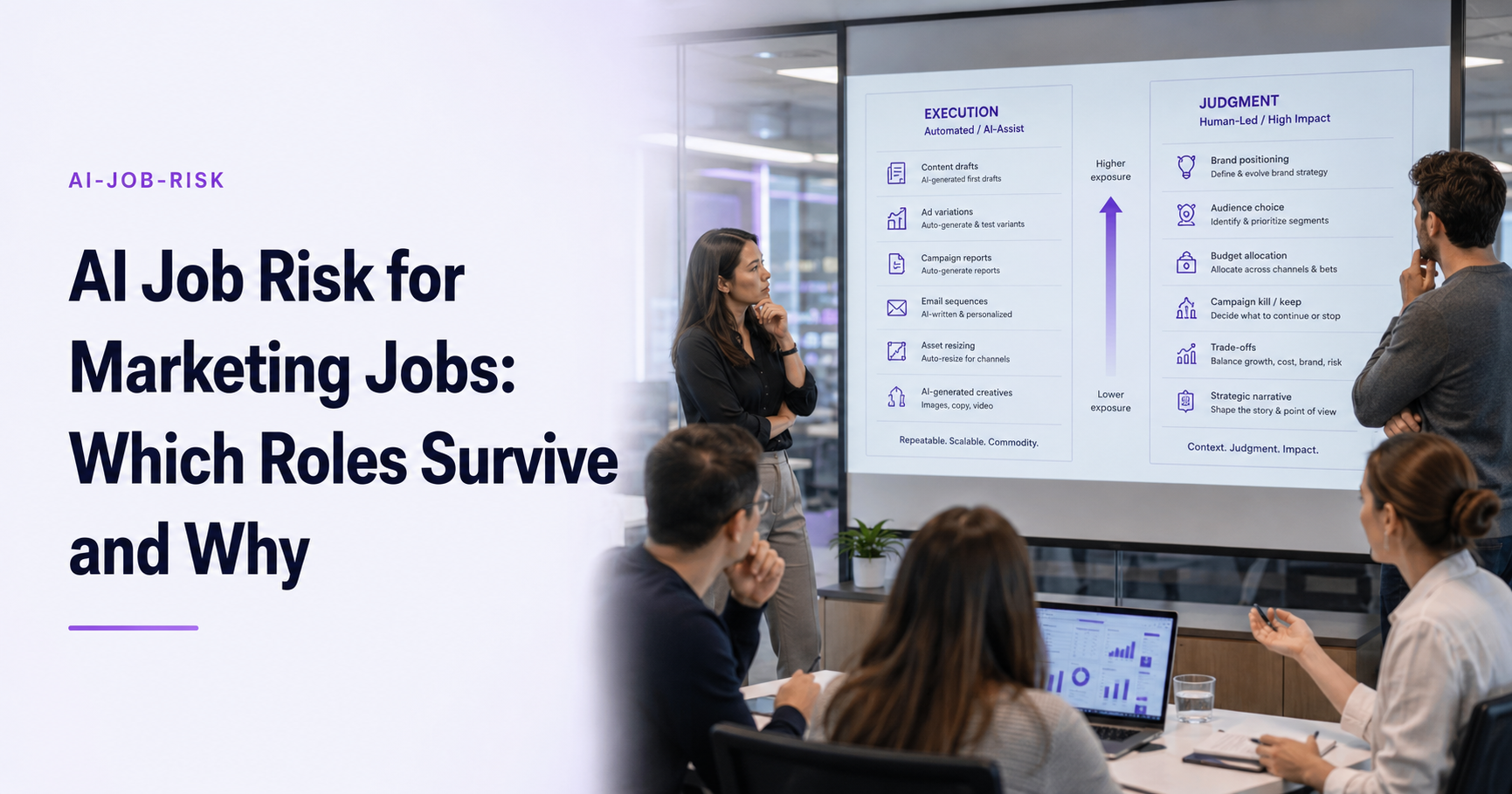
Walk into any marketing department and you’ll find two kinds of people. There are the ones who produce — writing blog posts, creating ad variations, pulling campaign reports, resizing assets. And there are the ones who decide — choosing which audience to target, determining what the brand should stand for, making the call on whether to kill a campaign that’s underperforming. AI is coming for the first group fast. The second group has more time, but not infinite time.
The exposed layer: marketing execution
Content production is the most obvious target. AI can write a first-draft blog post, generate dozens of ad copy variations, produce social media captions, and create email sequences in minutes. The quality isn’t always perfect, but it’s good enough for most performance marketing contexts where you’re testing fifty headlines and keeping the three that work. If your job is to produce volume — more posts, more ads, more emails — you’re now competing with a tool that produces volume at near-zero marginal cost.
Basic analytics is similarly exposed. Pulling campaign performance numbers, generating weekly reports, creating attribution summaries — these are structured, repeatable tasks that AI handles well. The data is clean (or at least structured), the outputs are predictable, and the format rarely changes. A marketing analyst whose primary job is “tell me how the campaigns did last week” is producing something that a dashboard plus an AI summary can handle without human intervention.
Design execution is moving in the same direction. AI can generate ad creatives, resize assets for different platforms, create variations for A/B testing, and produce social media graphics. It’s not replacing senior creative directors, but it’s absolutely replacing the junior designer who spends their day making banner ads in twelve sizes.
The protected layer: marketing judgment
Brand strategy is hard to automate because it requires understanding things that don’t live in data. Why does this audience trust us? What does our brand mean in the context of their lives? How do we position against a competitor without looking desperate? These questions require cultural awareness, taste, and the kind of intuition that comes from years of watching what resonates and what falls flat.
Campaign judgment is similarly protected. Deciding to pull budget from a channel that’s technically performing but attracting the wrong customers. Choosing to invest in a brand campaign that won’t show ROI for six months. Making the call to kill a viral piece of content because it conflicts with long-term positioning. These are decisions with trade-offs, and they require someone who understands the business beyond the metrics.
Audience intuition — the ability to sense what a market wants before the data confirms it — remains deeply human. The best marketers I’ve seen don’t just react to data. They form hypotheses about where attention is moving, test those hypotheses with small bets, and scale what works. AI can optimize within a known framework. It struggles to identify when the framework itself needs to change.
The distinction that matters: executors vs. strategists
The clearest way to think about AI risk in marketing is the executor-strategist spectrum. Executors produce outputs: content, ads, reports, assets. Strategists make decisions: positioning, audience selection, channel allocation, brand direction. Most marketing roles contain both, but the ratio determines your exposure.
A content writer who produces three blog posts a week on assigned topics is mostly an executor. A content strategist who decides what topics to cover, how to position the brand’s voice, and when to pivot the editorial calendar is mostly a strategist. The first role is highly exposed. The second is not — yet.
The uncomfortable truth is that many marketing teams are structured around execution volume. They have large teams producing content, managing ads, and generating reports. AI doesn’t eliminate the need for marketing — it eliminates the need for large execution teams. One strategist with AI tools can produce what used to require a team of five executors.
I wrote about why the concept of “AI-proof skills” is misleading in AI-Proof Skills Are a Myth. The same logic applies here: no marketing skill is permanently safe. But some are much harder to replace right now, and that’s what matters for the next five years.
If you want to see where your specific role stands, take the AI Job Risk Assessment. It breaks down your tasks, scores your exposure, and shows you exactly which skills to build next.
What people get wrong
The biggest mistake marketers make is thinking that “being creative” protects them. Creativity in the sense of producing novel content is exactly what AI does well. What protects you isn’t creativity as output — it’s creativity as judgment. The ability to look at ten AI-generated options and know which one will resonate with your specific audience, in this specific moment, given this specific competitive context. That’s taste, not production.
Another mistake: assuming that technical marketing skills (SEO, paid media, marketing automation) are safe because they’re “technical.” They’re not. AI is already writing meta descriptions, optimizing bid strategies, and building email automation flows. The technical execution is exposed. The strategic decisions behind it — which keywords to target, how to allocate budget across channels, when to change the automation logic — are what remain human.
What stronger marketers do
Marketers who are hardest to replace have moved beyond execution into decision ownership. They don’t just run campaigns — they decide which campaigns to run and which to kill. They don’t just produce content — they define what the brand sounds like and why. They don’t just report on metrics — they interpret what the metrics mean for the business and recommend action.
They also build the kind of market intuition that comes from direct contact with customers, not just data about customers. They talk to buyers. They read support tickets. They sit in on sales calls. This gives them context that no model has access to — the unstructured, emotional, contradictory reality of how people actually make decisions.
The skills that matter most now are the ones I covered in What Skills Should I Learn Because of AI. For marketers specifically: learn to frame problems, own trade-offs between brand and performance, communicate decisions under uncertainty, and recognize when AI-generated content is technically correct but strategically wrong.
Practical takeaway
If you’re in marketing, audit your role honestly. What percentage of your week is execution (producing content, running campaigns, pulling reports) versus strategy (making decisions about positioning, audience, and resource allocation)? If execution dominates, you need to shift — either by moving into a more strategic role or by becoming the person who directs AI tools rather than competing with them.
The marketers who will thrive are the ones who treat AI as their production team and focus their own time on the judgment calls that determine whether the production matters. That means owning the “what” and “why” while letting AI handle the “how many” and “how fast.”
If you want a structured way to evaluate your exposure and build a plan, take the AI Job Risk Assessment. It breaks down your tasks, scores your exposure, and shows you exactly which skills to build next.